
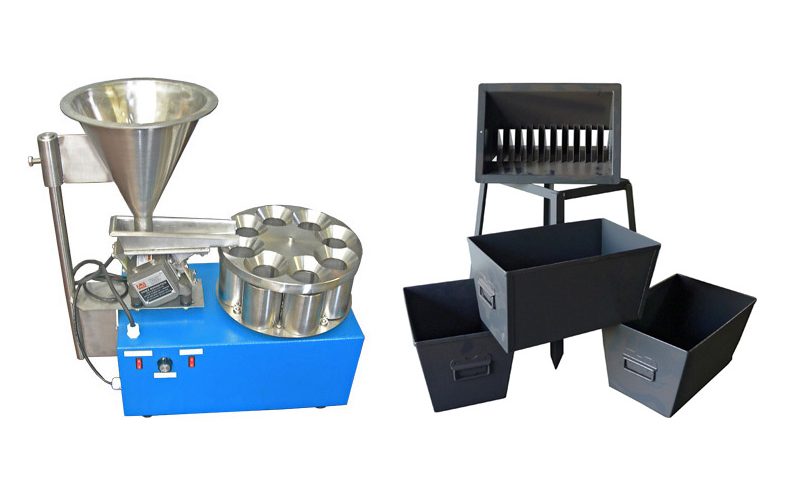
Every lab that processes bulk material runs into the same problem: you’ve got a large, non-uniform sample and you need a small portion of it that’s genuinely representative of the whole.
Get the split wrong and every test that follows, moisture, assay, particle size, is built on a number that doesn’t reflect the real material. RSE Projects manufactures three devices built to solve this in different ways: riffle sample splitters, Rotary RSD splitters and the two-way slurry sample divider. Which one belongs on your bench depends on what you’re splitting, how much of it there is, and how tight your repeatability needs to be.
How Splitting Introduces Error in the First Place
Any device that divides a sample can introduce two kinds of error: uneven flow or segregation during pouring (the sample itself wasn’t presented to the splitter evenly), and a biased division where one half consistently gets more of a particular particle size or mineral fraction than the other.
Standardised procedures because the reduction method must be proven not to distort the result. The practical takeaway for a working lab is simpler: the more consistently a splitter controls how material is presented to it, the more you can trust the two halves it produces.
Riffle Splitters: Fast, Economical, and Still the Right Call
A riffle sample splitter, also called a sample divider with chutes or, in some catalogues, a jones riffle splitter, is the most widely used sampling device for dry, free-flowing granular product.
A homogenous sample is poured evenly into the feed hopper, flows through alternating slots, and lands in two collection bins as two representative subsamples. It’s a manual process with no moving parts, which is exactly why it’s fast and cheap to run.
RSE Projects builds these locally in mild steel powder coated or 304 grade stainless steel, with slot widths from 6,7mm up to 53mm depending on the maximum particle size you’re working with.
For occasional splits of dry ore, cement, coal, or soil where volumes are moderate, a riffle splitter does the job without any setup or calibration overhead.
Rotary RSD Splitters: Better Reproducibility for Repeat Testing
A rotary cascade splitter, also known as a rotary sample divider (RSD) or spinning riffle, replaces the operator’s pour with a vibrating feed tray that meter’s material into a ring of collection cups (available in 6, 8, 10, 12 or 16-way models) as the ring rotates beneath it.
Because the feed rate is mechanically controlled rather than dependent on how evenly someone pours, a cascade splitter is the more reliable method for equal mass reduction where a lab needs to pull the same accurate result test after test.
This is well documented in the sampling literature; published sampling error analysis shows that controlling feed rate and loading is what actually drives error down, which is precisely what a rotary design automates. Metallurgical and assay laboratories, universities, and food and pharmaceutical testing facilities lean on rotary splitters where the sample is run repeatedly and consistency between splits matters more than the extra cost of a motorised unit.
Two-Way Slurry Sample Divider: For Wet, Not Dry, Samples
Neither a riffle box nor a rotary splitter is built for liquid; mine process laboratories regularly need to split a wet slurry stream into two representative portions for mineral content testing.
RSE Projects’ two-way slurry sample divider does that with a stainless steel feed hopper, a motorised agitator to keep solids in suspension, and a geared splitting cutter that divides the agitated sample into two 30 litre sample vessels. If what’s coming off your process line is wet, this is the only one of the three devices designed for it; running a slurry through a dry splitter will just clog the chutes.
Choosing the Right Splitter by Sample Type and Volume
| Sample Type | Typical Use Case | Best Device | Why |
| Dry, free-flowing granular (ore, cement, coal, soil) | Occasional splits, moderate volumes | Riffle splitter | Fast, economical, no moving parts to maintain |
| Dry, free-flowing, tested repeatedly | Metallurgical assay, high-frequency lab work | Rotary cascade splitter (RSD) | Controlled feed rate improves reproducibility |
| Wet slurry from a process stream | Mine laboratory process sampling | Two-way slurry sample divider | Only design built for liquid and suspended solids |
| Fine, cohesive or sticky powder | Small batch, manual lab work | Riffle splitter (enclosed model) | Rotary units feed inconsistently with cohesive material |
As a rule of thumb: if it pours like sand, start with a riffle splitter and move to a rotary cascade splitter once repeat accuracy becomes the priority. If it pours like a liquid, the slurry divider is the only option of the three.
Where Splitting Fits in Your Sample Preparation Line
Splitting is rarely the first or last step. Bulk material coming off a stockpile or drill programme is often reduced in size first with jaw crushers, and the original increments are frequently drawn using sample augers before a splitter is used at all.
RSE Projects supplies, services and repairs this whole chain for laboratories and mining operations across South Africa, so whichever splitter suits your sample, it’s built to work alongside the rest of your equipment. See the full range of sample preparation equipment for crushers, mills, sieve shakers and augers that pair with any of the three splitters above.
Not sure which splitter fits your sample and volumes? Talk to RSE Projects and we’ll help you specify the right one.


