
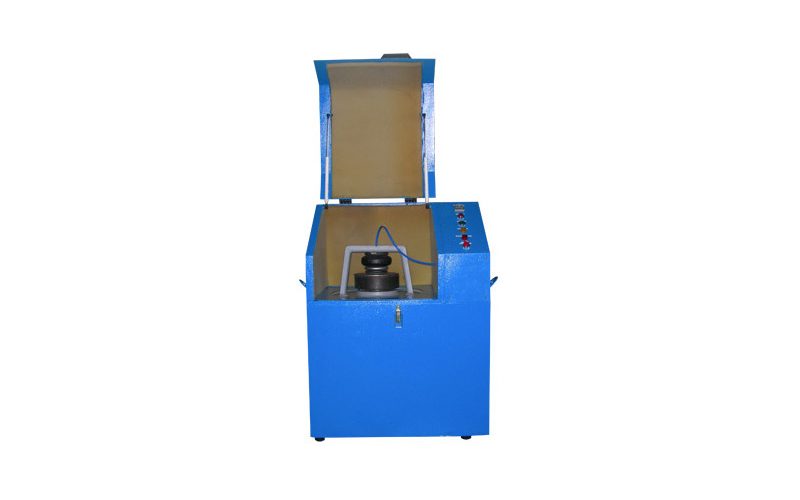
Ask three South African labs what this machine is called and you will get three answers: barrel mill, pot mill, or pulveriser. Some catalogues add swing mill or ring mill. They all describe the same thing.
RSE Projects manufactures barrel mills and pulverisers in single pot, 3 pot and 6 pot configurations, and the question worth settling before you specify one is not what a pulveriser does.
It is how many pots you actually need. That single decision sets your samples per shift, your bench space, your power and air requirements and, in most labs, your real cost per sample.
What a Pulveriser Does in the Sample Preparation Chain
A pot barrel mill grinds pre-crushed material down to analytical fineness. The pot is a sealed steel vessel holding a ring set and a puck. The mill clamps the pot and oscillates it at speed, and the loose rings and puck grind the charge against the pot wall by a mix of impact and attrition.
RSE’s pot mills take a feed size of 12mm to 15mm and reduce it to approximately less than 75 micron, although the fineness you achieve depends on the material and how long you run the cycle.
That feed size tells you exactly where the mill belongs. It is not a primary machine. Run-of-mine lumps must go through jaw crushers first, and in most labs the crushed material is then split down to a working mass on a RSD splitter before it ever reaches the pulveriser.
What comes off the mill is the powder that goes to XRF, fire assay or spectral analysis, which is why pot mills are so heavily used in mineralogy, metallurgy, materials research and construction materials testing. Where you need wet grinding, or a coarser product with grinding media, that is Rod and Ball mills territory rather than a pot mill.
What Actually Changes Between Single, 3 and 6 Pot
Only one thing. How many pots the mill clamps and drives per cycle. The grinding action inside each pot is identical across the three machines. A 6 pot barrel mill does not grind finer or faster than a single pot barrel mill, it grinds six samples at a time and the single pot grinds one sample.
On paper that makes the decision simple arithmetic. If your cycle is three minutes, a single pot gives you 20 samples an hour of grinding time and a 6 pot gives you 120. Run that calculation on your own cycle time and your own ore rather than a generic figure, because both move around considerably with material hardness and target fineness.
In practice the arithmetic breaks down, and this is the part most buyers get wrong: grinding time is rarely what limits a pulveriser. Cleaning is a three-minute grind followed by a five-minute clean-down means your 6 pot mill spends most of the shift standing still while an operator works at the sink. Before you buy stations, be honest about how many pots your team can realistically clean per hour, because that number, not the motor, sets your throughput.
Footprint and power scale with pot count in the way you would expect. A single pot unit in its soundproof cabinet is the smallest and lightest option and the easiest to place in a crowded lab. A 6 pot mill needs a larger cabinet, more clearance around it to load and unload comfortably, a heavier bench or floor mounting, and a bigger electrical supply. Cost per sample moves the other way: capital cost per station drops as pot count rises, but only if you keep the machine fed.
A 6 pot mill running two pots at a time is more expensive per sample than a single pot mill running flat out.
| Configuration | Samples per cycle | Suits | Check before you order |
| Single Pot Barrel Mill (S.P.B.M.) | 1 | Exploration and site labs with occasional assay batches, universities and research groups, and any lab where one sample type dominates | Whether one station will still cope if sample volumes double, since capacity cannot be added later |
| 3 Pot Barrel Mill | 3 | Mid-volume metallurgical and commercial labs running steady daily batches, or labs that want to dedicate pots to different sample streams | Footprint and clearance for loading, and how many spare pots you will run in circulation |
| 6 Pot Barrel Mill | 6 | High-throughput commercial assay labs, mine site labs feeding a plant, and pilot plant work with continuous sample flow | Power supply and compressed air availability, plus whether cleaning capacity can keep six pots fed |
Grinding Pots and Vessels: Volume, Steel and Ring Sets
The pot is where most of the specification detail sits, and it is also the part you will keep buying. RSE’s grinding pots and vessels are fabricated in either carbon steel or chrome steel, in 10cc, 50cc, 100cc, 250cc and 800cc capacities, and each pot is supplied complete with its ring set, lid and lid o-ring. Other volumes are made on request.
Pot volume sets your sample mass, and it is worth matching properly rather than defaulting to the largest available. Overfilling a pot is the most common cause of a course, out-of-specification grind, because the rings and puck lose the room they need to move.
Underfilling wastes cycle time and adds unnecessary media wear to a sample that did not need it. If you routinely prepare a 100 gram charge for assay, a 250cc pot is a sensible working size; the 10cc and 50cc vessels exist for small research and mineralogy samples where material is scarce.
The carbon steel against chrome steel choice is usually presented as a wear question, and partly it is. Chrome steel is harder and holds its dimensions longer on abrasive ore, so it is the better economic choice for a lab pushing volume through quarzitic or highly siliceous material. Carbon steel costs less and is perfectly adequate for softer samples and lower duty cycles.
The more important half of that decision is analytical. Grinding media wear does not disappear, it ends up in your sample. A chrome steel pot contributes chromium, iron and manganese to every charge it grinds, which matters a great deal if any of those are on your analyte list.
The ITRC guidance on sample processing makes the point directly, advising labs to avoid high chrome steel where low ppm concentrations of chromium are of interest. For a South African lab working chrome, PGM or stainless feedstock, that is not a theoretical concern. Specify pot material against what you are measuring, not only against what you are grinding.
Ring sets are consumables in the same way jaw plates are. They wear, the gap between ring and pot wall opens up, and your grind quietly drifts coarser without anything obviously breaking. Building a ring set replacement interval into your maintenance schedule is cheaper than discovering the drift in a round of failed duplicate assays.
Why Local Manufacture Matters More on a Pulveriser
Pots and ring sets are consumables, which changes the import calculation. A crusher might need a jaw plate once a year, but a busy pulveriser works through ring sets and eventually pots as a matter of routine. If those are coming from overseas, every replacement cycle is a freight wait, and labs end up either running worn media longer than they should or carrying expensive stock to avoid it.
RSE Projects manufactures from Johannesburg, quotes roughly six to eight weeks from order on grinding pots and vessels, and makes non-standard volumes on request rather than telling you to work with what the catalogue offers.
When something does go wrong, on-site or workshop service and repair is available locally, and the rest of the sample preparation equipment chain feeding the mill comes from the same workshop. For laboratories serving South Africa’s mining industry, where a stalled pulveriser holds up every assay behind it, that proximity is worth as much as the specification.
Choosing Between the Three
Start with your realistic daily sample count, not your best month. If it is occasional or single-stream, a single pot barrel mill will serve you and leave budget for a proper set of pots. If you are running steady daily batches, the 3 pot is usually the sweet spot, because three stations plus a healthy pot inventory keeps the machine busy without outrunning your cleaning capacity.
Go to 6 pot when you have the sample flow, the operators and the power supply to keep all six working, because an under-fed 6 pot mill is simply an expensive single pot mill.
Not sure whether your volumes justify 3 pots or 6, or which pot material suits your analyte list? Talk to RSE Projects and we will help you specify the mill and the pots together.


