
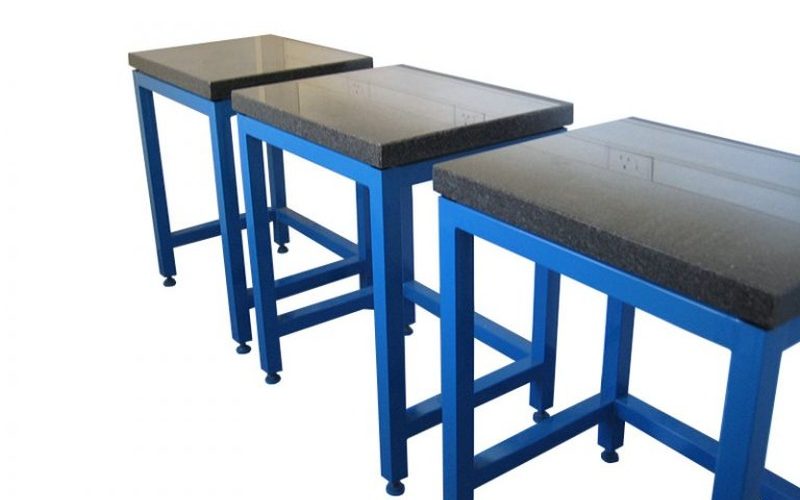
Since lab balances are extremely sensitive, they should always be placed on a solid surface such as a balance table, avoiding direct sunlight and any vibrations, air currents, or static electricity, in a room with a stable temperature. While barely noticeable to us, these disturbances can affect the measurements or the sample, often resulting in fluctuating readings, longer stabilisation times, as well as reduced accuracy or repeatability.
Whether your lab balance truly needs a balance table largely depends on its readability, weighing tolerance, and the surrounding environment. See our guide on when your lab might need a balance table:
When Do You Actually Need a Balance Table?
If you utilise lab balances in your laboratory and your standard lab bench cannot isolate the balance from floor, structural, or equipment vibrations, then you most probably need a balance table.
Lab balances have high readability, ranging from 0,001 grams to 0,0001 grams, which means they often drift or struggle to stabilise on ordinary benches. Working on a balance table mitigates vibrations from footsteps, traffic, closing doors, and HVAC systems that often cause unstable or ‘ghost’ readings.
Industries that demand strict accuracy and compliance standards often make use of balance tables, as it is vital for operators to produce repeatable, drift-free measurements.
If your laboratory or working environment features any of the following, you might want to consider acquiring a balance table:
- Your work involves high-precision weighing
- You are conducting tests in a vibration-prone room
- Working on flexible or non-isolated floors
- Working on unstable workbenches
- Your environment contains hazardous workflows or containment
When is a Standard Bench Enough?
Your lab probably does not need a balance table if your weighing tasks do not require high-precision measurements and your space already features a surface and environment that provides sufficient stability.
Platform scales or lab balances with lower readability needs (e.g. 0,1 grams or 0,01 grams) can generally tolerate minor floor and air movement. However, it is still a good idea to place your scale or balance in a spot away from heavy machinery, HVAC vents, doors, and foot traffic.
You might also not require a dedicated balance table if you have a heavy solid stone or marble countertop that is directly fixed to the ground floor or structural wall that can absorb vibrations on its own.
R.S.E Balance Tables
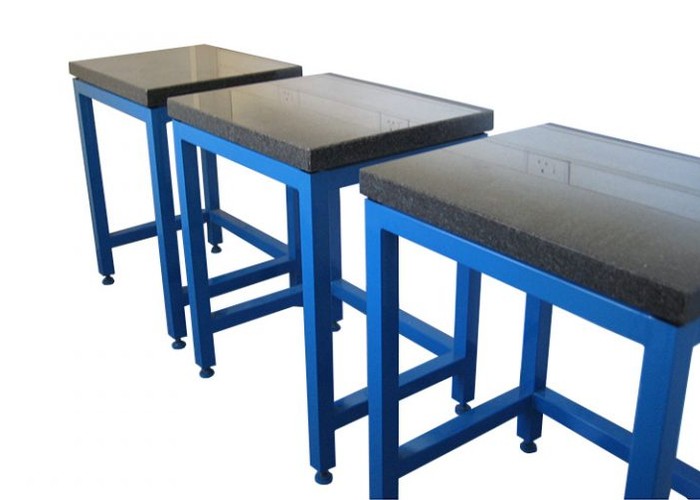
At RSE Projects, we offer a range of balance tables. All of our tables feature granite tops with anti-vibration rubber mounts, which prioritise flatness, vibration damping, and thermal stability. This in turn ensures that operators attain high-precision measurements that are accurate and consistent.
Each of our balance tables is fitted with adjustable feet on each leg, allowing operators to adjust the levelling of the table according to their needs. We also offer varying balance table sizes according to our customers’ requirements.
All of our balance tables are manufactured locally, so our customers don’t have to wait for their balance table to be imported from a continent away.
RSE Projects provides you with modern, cutting-edge equipment that is tailored to your exact requirements. Contact us today for a free quote on our balance tables.


